Help Fight Judonia!

Please help sustain EAAZI in the battle against Jewish Zionist transnational political economic manipulation and corruption.

For more info click here or here!

Monday, April 27, 2009

Jewish Financial Aggression, Worldwide Economic Nakba

Followup: Chop Shop Economics and Stealth Zionism

On April 6, Ira Stoll published a silly and rather poorly worded op-ed entitled Anti-Semitism and the Economic Crisis in the Wall Street Journal. Even though Stoll was writing only a little more that a month after Israel ended its rampage in Gaza, he proposed that hatred of Jews might increase with the world financial crisis as the result either of irrational gentile prejudice or of rational gentile unscrupulousness.

Stoll refers to questionable but Jewishly self-serving historical analysis from Benzion Netanyahu, who is the father of Israeli Prime Minister Binyamin Netanyahu:

As for the expulsion of the Jews from Spain in 1492, the foremost historian of its causes, Benzion Netanyahu (the father of Israel's new prime minister), writes of the desire of the persecutors "to get rid of their debts by getting rid of their creditors." More generally, he writes, "it is an iron-clad rule in the history of group relations: the majority's toleration of every minority lessens with the worsening of the majority's condition."

In fact, a lot of Spanish debt -- possibly most -- was held by formerly Jewish New Christians, who were not subject to expulsion. Because the Spanish government expelled Muslims as well as Jews, a much more plausible explanation for the expulsion might lie in the desire of Spanish Christians to have a religiously homogeneous state after approximately 600 years of religious warfare.

Netanyahu's iron-clad rule does not even apply to his native Poland, where economic crisis rarely -- if ever -- created hostility toward Saxon, Armenian, Muslim Tatar, or Karaite Jewish Tatar populations, who were all generally perceived as honest in their dealings with people outside their groups.

Sometimes Jewish Tatars suffered secondary effects from hostility toward ethnic Ashkenazim, but more generally towards the end of the 19th century, Jewish Tatars were becoming just as annoyed with ethnic Ashkenazim as ethnic Russians or ethnic Poles were.

Stoll concluded his essay by turning from the historical to timeless religious concepts:

It may yet be that the Jews escape the current economic crisis having only lost fortunes. But if not, there will have been no lack of warning about the threat. When Jews gather Wednesday night for the Passover Seder, we will recite the words from the Hagadah, the book that relays the Israelite exodus from slavery in Egypt: "In every generation they rise up against us to destroy us." This year, they will resonate all the more ominously.

While Stoll could hardly have found a better means to absolve Jews of any legitimate grievances that non-Jews might have against Jews either for shameless financial aggression or for heinous slaughter of non-Jews, he probably was not incorrect in focusing on long standing financial issues instead of the latest Zionist atrocity against Palestinians, for Jews are disproportionately represented among America's hyper-wealthy plutocrats, business leaders, business reporters, academics in finance or economics, and policy makers in finance or economics.

As an increasing number of people have begun to understand the scale of the financial disaster and the role of leading Jews in creating the disaster, the organized Jewish community has shown increasing signs of panic

  • that Jewish finance and economic leaders might actually be held accountable for their crimes or incompetence and
  • that at the very least Jewish access to political and economic power might decrease in the USA.

The organized Jewish community and Israel advocates have developed two major strategies for dealing with this threat.

The primary effort focuses on blame-shifting or distraction via incitement against Arabs and Muslims. During the presidential campaign, the Clarion Fund acting as a front for Aish haTorah, Honest Reporting, the Republican Jewish Council (RJC) and probably several hyperwealthy Jewish plutocrats distributed the Islamophobic documentary Obsession, Radical Islam's War Against the West. Then the anti-Arab anti-Muslim campaign became personal with demonization of Rashid Khalidi, who is an Arab American professor at Columbia University. Since the Obama inauguration the RJC, various Israel advocacy organizations and various official Jewish groups have been treating various communities throughout the US with visits from notorious Dutch Islamophobic politician Geert Wilders, who does a dog and pony show to demonstrate that Western Muslims represent a barbarian threat comparable to Hitler and the German Nazis.

Because eight years of Bush Administration and Jewish Zionist Neocon scare-mongering has worn out the shock value of the Islamic threat, the Jewish community and the Israel Lobby have pursued a secondary strategy to make Americans feel guilty for doubting Jewish competence in finance or for harboring negative thoughts about the role of Jews in the American political, social, academic or economic system. There has been an ongoing effort in the media to create a hagiography about Larry Summers, Ben Shalom Bernanke and other Jewish economists or finance experts. The campaign has the appearance of an attempt to create a form of Gramscian hegemonic blocking to prevent Americans from harboring doubts about the competence of Jewish policy makers like Summers, who has a record of almost unadulterated misunderstanding and failure.

With or without awareness President Obama has been recruited to quiet suspicions about the good will of Jewish bankers through an encomium of Leonard Abess, Jr. while Obama's recent speech at the United States Holocaust Memorial Museum effectively put any qualms about excessive Jewish representation or influence in the US government or economy in the category of the most vile possible German Nazi anti-Semitism.

Yet the size of the current financial disaster, the role of leading economic or financial experts in causing the collapse, and the absence of warning with few exceptions from academic economists should put the "science" of economics in doubt. Economics is not math, and measuring tangible quantities is probably the least important aspect of the field. Over the last decade or so economists have attempted to introduce ideas of evolution or social psychology into the system, but these efforts are beside the point. Finance and hence economics is driven by corruption, manipulation, and conspiracy, which are intangibles hard to measure especially in combination with other intangibles like ethnicity or nationalism.

The major recent economic disasters like the Panic of 1873, which preceded the Long Depression, the Great Crash of 1929 that became the beginning of the Great Depression, and the current economic disaster all had Jewish aspects and seem to have originated with misbehavior within in Jewish networks of trust.

While the Long Depression itself is much disputed, the triggering event of the preceding panic was the collapse of the investments of the converted Jewish speculator Bethel Strousberg with concomitant ruination of many trusting Jews and non-Jews. If there was a Long Depression, which many modern experts doubt even if the losers did not, it lasted either 17 or 27 years according to different ways of looking at the data.

The Great Crash began in 1929 when the leverage of closed-end funds of the German Jewish American Goldman Sachs investment bank began to operate in reverse and wiped out a tremendous amount of stock value to create a panic among investors. Both Milton Friedman and Ben Shalom Bernanke analyzed the Great Depression, and neither Jewish economist could discern a Jewish ethnic contribution to the Great Depression even though the US investment banking industry had long be wracked by a sort of ethnic competition or warfare between the Jewish and non-Jewish firms. The conflict was particularly strong in the 1920s until Goldman Sachs began to operate its own leveraged closed end funds. At this point determining how decisions were made is difficult. Top management could have made the choices, but then as now Jewish financiers worked together through informal networks of trust to protect one another or to share information and sometimes strategies.

The preponderance of the evidence suggests that Jewish investment professionals sometimes operating against their own banks took derivative positions based on likely Federal Reserve behavior while many bankers short-sold and hedged against over-leveraging in the closed-end fund market. Overall the banking community advised the Federal Reserve Board of Governors to pursue of policy of contracting the money supply with the result of transforming the 1929 Crash into the Great Depression.

Little actual persuasion was necessary to convince the Federal Reserve to pursue exactly the same policies it had followed successfully in 1924 and 1927. The combination of Federal Reserve behavior and anti-Fed bets managed to exacerbate the Great Crash into the Great Depression while some mostly Jewish bankers became disproportionately cash rich.

The ultimate scope of the economic downturn was probably not anticipated. It lasted for the most part until the beginning of WWII in the USA (or 1946 by some analysts) even though Germany managed to achieve recovery by 1936. During the Great Depression the Jewish and non-Jewish investment banks acquired valuable equity and assets at fire sale prices, but Jewish institutions did distinctly better.

Even though anyone familiar with Yiddish literature or E. European ethnic Ashkenazi history must be aware that Yiddish Jews were heavily involved in all sorts of financial violence or manipulation during the second half of the 19th century, the Great Crash and Depression involved few Eastern European ethnic Ashkenazim because Yiddish Jews on the whole did not yet have enough capital in the USA to take part in major financial skullduggery.

Because of the nature of the hegemonic American discourse about Jews, any discussion Jewish economic or financial violence is subject to accusations of anti-Semitism, and the public is never even permitted to address the need for reform of Jewish economic behavior

  • even though politicians routinely talk about African American male propensity to petty violent and criminal behavior and
  • even though an African American politician like Barack Obama is counted as courageous for telling young black males to get their act together.

In reality African American culture suffers from various forms of structural inequalities that resulted from Civil War and US government behavior in the decades that followed and over which young African American males have no control whatsoever. In contrast, modern Jewish behavior has developed out of some very specific legacies inherited from ancient and medieval Judaism.

Seth Schwartz discusses the concept of virtualization of the community of Israel in Imperialism and Jewish Society, 200 B.C.E to 640 C.E. on pp 287-8:

The Local Community and the Community of Israel

We have already seen that the ideology of self-enclosure may often have been in tension with wider social and economic realities. That it was in tension even with religious realities is obvious enough. After all, by around 500 all Palestinian Jewish settlements shared the ideology and all that went with it­the synagogue, the symbolic centrality of the Torah, and so on. Some commu­nities, furthermore, were aware of the tension between their self-conception as loci of religious obligation and meaning, and the biblical view of Israel, inherited by the rabbis, as a single people. On the mosaic pavement of the narthex of their sixth- or early seventh-century synagogue, the Jews of Jericho wrote the following.

May they be remembered for good, may their memory be for good, all the holy congregation (qahalah qadishah), great and small, whom the King of the Uni­verse helped so that they pledged" and made [i.e., paid for] the mosaic. May He who knows their names, and those of their sons and the members of their house­hold, inscribe them in the book of life with all the righteous. (They are) friends to all Israel. Peace [Amen].

The language of this inscription was derived from a communal prayer that until recently was known (in Aramaic) only from the prayer books of Kaffa-­Feodosiya in the Crimea, and Cochin in India, both known only in copies printed in the eighteenth century Traces of the prayer have now been de­tected among the fragments of the medieval Palestinian liturgy discovered in the Cairo genizah, and the Jericho inscription seems to prove beyond a doubt that the prayer originated in late antique Palestine. How widespread it was there we cannot tell, though components of the Jericho inscription are paral­leled at Hamat Cader, Alma, Dalton, Susiyah, and Chorazin." Of special interest is the conclusion of the inscription, haverim lekol Yisrael, a formula preserved in the traditional Ashkenazic prayer book, with a slight change, to haverim kol Yisrael (all Israel are friends), only in the inappropriate-seeming context of the conclusion of the blessing of the new moon [see note]. It seems obvious that this exclamation is intended to qualify or mitigate the powerful expression of the religious significance of the local community that it follows; contrary to what we may sometimes imagine, it seems to say, we are part of the larger community of Israel.

[Note: "May He who performed miracles for our fathers and redeemed them from slavery to freedom redeem us soon and gather our dispersed members from the four corners of the earth. All Israel are friends, and let us say, Amen." Here the local community is implicitly represented as a by-product of the exile, an imperfect condition from which we pray to be released, while we continue to affirm the unity of the people of Israel. The message is different from that of the Palestinian communal prayer.]

In late antiquity communities that practice a form of pre-Rabbinic Judaism developed a belief in their membership in the larger community of Israel. While such thinking differed little from comparable Christian conceptions, the pre-Rabbinic communities were not connected to a clerical hierarchy that provided governing authority and oversight.

The pre-Rabbinic virtualization of the pre-Rabbinic nation of Israel served as preparation for the great Medieval Rabbinic Jewish revolution which transformed pre-Rabbinic Judaism into a network of Medieval Rabbinic Jewish communities linked together by a trading network and by a sacred law, whose business and commercial rules and regulations were particularly well developed.

By the early medieval period Rabbinic Judaism is completely deterritorialized, and the Land of Israel is a spiritual concept that only plays an eschatological role. Maimonides' great law code and enumeration of the commandments contain neither obligation to settle the Land of Israel nor -- to the dismay of the anti-Zionist Satmarer Rebbe Teitelbum -- any law forbidding settlement. The physical Land of Israel simply was not important to Medieval Rabbinic Judaism.

The medieval Jewish trade network facilitated by codification of Jewish Law extended throughout the Christian and Muslim world into SE Asia and over the Silk Road in China.

The medieval commercial system laid the foundation for the Jewish business social networking system

  • that gave Jews so many advantages over gentile competitors,
  • that created Central and Western European Jewish wealth,
  • that survived into the modern period, and
  • that faced disruption by secularization and modernization.

One other pre-modern or early modern innovation or set of innovations was critical to the development of such Jewish networks and necessary both to the creation of modern Jewish culture and also to the establishment of the modern Zionist political economic system.

The Polish government from the medieval to early modern period treated different ethnic groups functionally in a sort of caste system and gave them full autonomy as long as they fulfilled their designated role. Polish Armenians had a governing council called the Voit while in principle the Council of the Four Lands, to which the most important Jewish communities (kehillot) sent delegates, ruled Polish Jewry from the 16th until the 18th century when the Jewish Council failed to meet its tax obligations.

The Polish government effectively gave Polish Jews control of internal distribution of goods within Poland in addition to the role that they played in international trade from the beginning of the development of a distinct Polish Jewish community.

From the 16th century onward a segment of Polish Jews partnered with the magnate class of Polish Szlachta (Gentry) in the highly exploitive arenda (estate management) system, which squeezed the serfs and peasants for practically everything they had and which has tremendous similarity to Friedmanite Neoliberal economic doctrine.

Because increasing Jewish economic might was potentially threatening to the Polish ruling class, Polish Jews began to affect a sort of effeminate public style and culture in order to demonstrate that Jews were really harmless and that non-Jews should not be worried at the wealth and influence that Jews were gaining.

The new effectively hyperwealthy Polish Jewish estate manager class co-opted the Rabbinical intellectual leadership in a development that was eventually to split the Jewish community in several ways and to create a very early form of class-based factionalism among Polish Jews.

The arenda system probably set Polish economic development back centuries and eventually led to the collapse of Poland into the world’s first modern failed state when the Ukrainians rebelled in the 17th century.

Polish Jewish politics went transnational as the Prussians, Russians and Austrians divided historic Poland. Russian and internal Jewish attempts to reform the Jewish community shattered communal control of internal ideological deviance while increasing Jewish population with simultaneous shrinking of the traditional Jewish economic sectored created a Jewish working class and proletariat at the same time that the Czarist government was failing to modernize as fast or as well as its Austrian and German competitors.

Jews from Prussian and Austrian Poland began to emigrate into Austrian and German territories and to Yiddishize the local Jewish populations just as Austrian and German Jews began to emigrate to the United States. In addition as Polish nationalist feelings began to develop in occupied Poland, the magnate class began to feel closer to exploited and oppressed Polish peasants than to its erstwhile Jewish allies.

In effect, formerly Polish Jews became an extremely disaffected former elite, whose leading members felt they were deprived of the status, power, and wealth, which they considered their right at the same time

  • that the Jewish working class was beginning to feel exploited by the Jewish proprietor class,
  • that the newly developing Jewish intelligentsia was looking for a source of income and populations to mobilize, and
  • that wealthy Western European Jews were looking for ways to invest in the Wild East of E. Europe and the Czarist Empire.

In addition, during the late 1840s and early 1850s part of the Russian Jewish community turned revolutionary and became involved in an increasing amount of sabotage, radical violence and targeted assassinations.

When the non-Zionist French Rothschild family sought to invest in Russian Caucasian oil in the 1870s, it took part in early Zionist schemes to send Russian Jews to Palestine as a way to alleviate revolutionary pressures in the Czarist Empire.

When Jewish led revolutionaries assassinated Czar Alexander II, the violent popular response led to large-scale Russian Jewish emigration to the USA at the same time that Jewish intellectuals began to dominate the non-Jewish revolutionary movement that included both a large number of disaffected Russians and also a larger number of even more disaffected members of Russianized populations.

A much smaller group within the Russian Jewish intelligentsia began to dream of creating its own empire by mobilizing Western European Jewish wealth for a colonial enterprise that would send lower class Russian Jews to Palestine and that Jewish intellectuals would direct from European capitals.

Even though practically no Western Jews had any interest in immigrating to Palestine and even though working class Russian Jews were much more interested in revolution than in colonialism, Zionist colonialist ideas were far from ridiculous. There were more Yiddish Jews than there were Danes or Croats, and Western European Jewish wealth and effective GDP was far larger than those of Denmark, which was running a fairly respectable colonial empire at the time. With or without awareness the Zionist movement was proposing a low budget colonial empire that would be run from a virtual colonial motherland among the Jews of Central and Western Europe.

The Austrian journalist Theodor Herzl and his fellow Congress or Political Zionists found an effective marketing strategy in using the Dreyfus Affair to scaremonger wealthy Western Jews with fears of imminent pogroms at the same time Congress Zionism created a sort of liberal enlightened national Jewish identity that could substitute for the traditional religious faith and sacred law on which the Jewish networks of trust so strongly depended. Such networks of trust gave Jews immense competitive advantage in both business and finance as well as more recently in both the arts and academia.

Because all major European states encompassed multiple ethnic or national groups at the time of Herzl, the Congress Zionist concept of liberal Jewish national identity made sense in the Old World context.

Because citizenship and nationality are congruent in the USA, the famous German American Jewish lawyer Louis Brandeis developed and proselytized a form of Congress Zionism stripped of the idea of a separate Jewish national identity as a way of bringing liberal Enlightenment values to immigrant Yiddish Jews in order to Americanize the newest segment of the US Jewish population.

Thus, Brandeis originated the form of Zionist ideology that is called Refugeeism and that was compatible with the philanthropic politics that German American Jews practiced, that still characterizes the American Jewish community, and that expresses itself at its most hypocritical in the Southern Poverty Law Center and the Save Darfur movement.

More or less simultaneously with Brandeis’ conversion, the Zionist movement brought wealthy members of the British Rothschild family into the fold. There was a strong element of economic self-interest in the Rothschild Zionization because the British Rothschilds desperately wanted to invest in Mesopotamian oil. Members of the family could easily discern a value both to dismembering the Ottoman Empire and also to creating a Jewish colony in Palestine to which a pipeline from Mesopotamia could be directed.

The Zionist members of Rothschild family influenced some of the chief families of the Cousinhood of the wealthiest British Jewish to become Zionists. The combined Jewish wealth fairly quickly brought forth the Balfour Declaration possibly in part as an exchange for information about the Zimmerman Note that so enraged the US Congress and that brought the USA into WW1 on the side of France and Britain against Germany.

The section Judonia, Balfour Declaration and Afterward of Judonia Rising: The Israel Lobby and American Society documents the subsequent history of the Zionist movement in the UK and the USA from the issuance of the Balfour Declaration until the present day.

Nowadays, the State of Israel is the keystone in the Zionist imperial system, but commitment to Zionist ideology and beliefs fuels the corrupt Jewish social networking that has given Zionists such spectacular domination over the minds of Western leaders that European and European settler states walked out of Durban II when Iranian President Ahmedinejad stated the obvious about the nature of Zionism and the State of Israel.

Throughout the American media, Jewish Zionist networks of trust police Zionistically unacceptable opinions. Zionist networks of trust within US movie industry have long boycotted Vanessa Redgrave and other pro-Palestinian activists within the film industry.

Academic Jewish Zionist networks of trust have favored Zionist and Zionist-influenced academics willing to produce a ridiculous and nonsensical history of Central Europe, Eastern Europe, and the Russian Empire since 1850. American schools and universities dutifully indoctrinate Americans with such historical nonsense to guarantee reflexive support for the State of Israel even though Zionist ideology contradicts basic American principles.

Jewish Zionist networks of trust have so thoroughly penetrated the US government regulatory, the US criminal legal system, and the international legal system that Zionist organizations operate with impunity and without scrutiny throughout the USA and the world.

Jewish Zionist networks of trust made it possible for Jewish Zionists to manipulate Jewish officials and academics in the USA, the UK and France for the purpose of creating the Israeli atomic arsenal.

Yet no Zionist success has been greater than the manipulation and the looting of the US and world economy since the 1980s with concomitant creation of a Jewish Zionist plutocratic elite.

Revisionist (Jabotinskian) economic thought worked out the program in the 1920s and 1930s. Eran Kaplan writes on pp. 59-60 in The Jewish Radical Right, Revisionist Zionism and Its Ideological Legacy:

For the Revisionists the nation was the only social factor that could provide a complete economic framework that would benefit all its members. As Abba Achimeir put it, only the nation and its different organs were responsible for the economic well-being of its members. And, according to Achimeir, the most efficient way to run a national economy was to use protective tariffs to encourage local production while refraining from any intervention in internal eco­nomic and social relations.


Achimeir thus invoked the familiar dichotomy between the socio­economic infrastructure, which should be free from intervention from above, and the political and legal superstructures, which the state should control because it is responsible for setting the goals and guidelines of the national economy.


In a 1933 article Abba Achimeir analyzed the causes of the interna­tional financial crisis that followed the 1929 stock market crash. He argued that neither the Great War nor any other international con­flict had caused the crisis, as most economists had claimed. The cri­sis was the logical outcome of the demise of liberal and free-market economics. It marked the collapse of the international system, which suppressed the needs of nations in favor of abstract concepts that people could not relate to.

People, Achimeir claimed, were national, not economic, beings. Human society therefore should not be analyzed and constructed ac­cording to some abstract economic rationale. An economic model that was developed according to purely economic considerations led inevitably to an international system, whereas a nationalist ap­proach, Achimeir maintained, always led to an active economic real­ity, where the nation found itself in a constant state of war (to pro­tect its own market and overtake other markets).


In describing the organizational principles of the Revisionist youth movement Beitar, Ze'ev Jabotinsky stated, "The structure of Beitar and its sense of discipline are a successful and healthy combi­nation between freedom on the one hand and a monistic harmony on the other." The Revisionist economic model similarly combined the freedom of capitalist private ownership with the discipline of ac­tive state involvement in the operation of the national market.

The Jabotinskian approach to economics was compatible with traditional Jewish economic behavior. Even though Labor Zionists had rejected such economic practices as a result of E. European class conflict, such behavior quickly reestablished itself among Yiddish Jews as their children moved from the working to professional class.

When Begin took office in Israel, the Jabotinskians finally obtained state-power in Israel at approximately the same moment that American ethnic Ashkenazim, who were generally Jabotinskians, were taking over from the German American Jewish elite within the organized Jewish community, within Israel Lobby organizations, and throughout American business, society, and politics.

By 1980 the State of Israel was receiving at least $2 billion of unaccounted US foreign aid per year and could experiment with the type of ethnonational financial warfare of which Jabotinsky and his followers dreamed in the pre-State period.

The activities of new but traditional American Jewish networks of trust in combination with modern corrupt social networking dovetailed precisely with the implementation of the Jabotinskian program because the presence of Jewish Zionists in the US financial and media industries in combination with Israeli government support of strategic industries made it possible for Zionists to control all sides in a major financial transactions including the press coverage.

In effect the active state mentioned in the last sentence of last paragraph of the quote is not Israel or the United States but has become the Zionist virtual colonial motherland, which is squeezing the economic systems of subordinate states just as Polish magnates and Jewish estate managers squeezed the peasants and serfs of the Polish arenda system of the 17th century.

Suddenly in the 1990s, IPOs were taking place without the traditional four quarters of profitability, the process of seeking venture capital funding included vetting with regard to attitudes toward Zionism or the State of Israel, and an immensely powerful class of politically mobilized Zionist billionaires was created while the US economy was bled through a series of booms and busts from which Zionist oligarchs and their intelligentsia profited.

Because President Obama has put some of main members of the corrupt Jewish social networks in charge of undoing the disaster that corrupt Jewish social networking has created, there really is no discernible end to the perpetual world-wide financial nakba that is now tracking the perpetual Palestinian nakba that the Zionist state continues to exacerbate right before our eyes.

Sphere: Related Content

Saturday, April 25, 2009

Khaleej Times: Islamophobia on American Campuses

Karin Friedemann (LETTER FROM AMERICA)

26 April 2009

Muslim parents from around the world once sent their children off to school in America with simple warnings against wine and song, but now Muslim students must be prepared to face Islamophobic incitement.

While political activism makes college exciting, Muslims need to be aware that autonomously managed local Muslim Student Association university chapters are outclassed by well-funded, hierarchically coordinated Jewish and Neoconservative organisations, which actively work to undermine Muslim student groups.

The Jewish Anti-Defamation League, which blacklists professors for failure to teach the Zionist version of the Israeli-Palestinian conflict, labels MSA an “Anti-Israel” organisation and keeps detailed files on its activities.

Steve Emerson’s Terrorism Awareness Project published a “Student’s Guide to Stop the Jihad on Campus” manual for organising “Islam-Fascism Awareness Week,” whose stated goal is “to show the connections between the MSA and the international jihad.”

IFAW sponsored a panel discussion on “Islamic Totalitarianism’s Threat to Civilisation” with the Ayn Rand Institute and screened propaganda films.

[Click here to read the full article.]

Sphere: Related Content

Thursday, April 23, 2009

Classic Advertising Mistake: Arabic Version

My wife found the following funny story on line. Even though it is supposed to be fictional, it is completely plausible and reminds me of GM's attempt to market a car named Nova to Spanish speakers.
A disappointed salesman of Coca Cola returns from his assignment in Arabia.

A friend asked, "Why weren't you successful with the Arabs?"

The salesman explained, "When I got posted in the Middle East, I was very confident that I would make a good sales pitch in rural areas. But, I had a problem I didn't know how to speak Arabic. So, I planned to convey the message through three posters...

First poster- A man lying in the hot desert sand...totally exhausted and fainting.

Second poster - man is drinking our Cola.

Third poster- Our man is now totally refreshed.

Then these posters were pasted all over the place

"That should have worked," said the friend.

The salesman replied "I didn't realize that the in Arabic you read from right to left."
Sphere: Related Content

Followup: Harvard Sharia/Apostasy Debate

Greta provided an excellent summary of the Harvard Sharia/Apostasy Debate when she commented:
In the spirit of wrapping things up, let me offer this short summation of my personal reflections on this issue and the comments here:

1) The issue of whether Taha's views (or University-sanctioned position) are appropriate is one that can be debated openly and people of good will can disagree--if this incident serves to spur constructive debate about the modern practice of ancient faiths that is a good thing.

2) In pursuing these questions, we must be aware of the geo-political context--one in which the demonizing of Islam as part of specific political agendas is not properly understood by the public, and used to justify atrocities against Muslims.

3) A double standard exists that seems to make it acceptable to speak of arabs and Muslims in terms that we would not find acceptable if applied to ther groups.

4) A double standard exists that singles out Islam among the three Abrahamic faiths for special scrutiny, however appropriate that scrutiny may be in terms of our modern "hegemonic human rights discourse" for all three faiths and their canons.

5) The process of pointing out these double standards especially through examples, especially from Judaism, invites accusations of bigotry against those pointing them out, despite the fact that current geo-political reality (vis a vis the role played by Zionism in the middle east) is a context outside of which current discussions (esp. critiques) of Islam are not fully understandable.


Sphere: Related Content

Pro-Israel Students Deserve Pain, Suffering

If the Boston area is typical, JTA reporter Ben Harris distorts the report below in order to imply that anti-Zionism is anti-Semitic, for he neglects to mention that most of the anti-Israel leaders and activists on-campus are Jewish.

According to Boston-area anti-Zionists not only are Jewish Zionists and their non-Jewish panderers the enemies of Palestinians, Arabs, Muslims, Americans and the entire human race, but Zionism is nothing other than ethnic Ashkenazi Nazism, and it is simply racist to believe that Jews of all people on the planet could not be Nazis.

Because Jews are more likely to know the details and understand the issues in the conflict over Palestine, Jews often take the lead in the struggle against Zionism and in targeting Zionists, i.e., Jewish Nazis, for completely legitimate and much deserved abuse and scorn.

In many regards, the on-campus conflict marks a resumption in the wake of the IDF rampage through Gaza of 19th and 20th century political struggles between Zionist and anti-racist Jews.

Jewish, pro-Israel students feel threatened on college campuses

NEW YORK—At York University in Toronto, a group of students had to be escorted from the Hillel office by campus police on Feb. 11 after a threatening mob shouting anti-Semitic and anti-Israel slogans gathered outside.

At New York University, a group of students occupied a campus building and issued a series of demands that included measures supportive of the Palestinians. Similar demands were issued by students during a demonstration at the University of Rochester.

And at San Jose State University in California, Israel's consul general had to be escorted from a lecture hall by security officials after audience members grew agitated.

These are a few of the incidents that have galvanized Jewish organizations that say the climate on campus is unlike anything they have ever seen. The organizations note particularly the physical threats to and intimidation of Jewish and pro-Israel students.

"Jewish students are not comfortable and they're not feeling secure," Daniel Ferman, president of the York Hillel, told JTA. "But I think most importantly though, they're not happy with the situation. I think they're disappointed that there hasn't been more action. The university administration needs to take responsibility for its campus and ensure that it's a safe environment for all students."

Compared to the animus frequently directed toward Israelis in Europe, where calls for academic and cultural boycotts have become routine and even sports competitions involving Israelis attract scores of rock-throwing protesters—the situation at American campuses is relatively tame. But those involved in pro-Israel activism at U.S. colleges remain concerned that the situation is worsening, with rhetoric and tactics once thought rare in North America gaining increasing traction.

"There are a couple of things that make this rise unique and worrisome in my eyes," said David Harris, director of the Israel on Campus Coalition, a partnership featuring nearly three dozen Jewish organizations. "One is that we're seeing anti-Israel activity on campuses like Cornell and Queens College that have not for years seen meaningful anti-Israel activity."

A second trend Harris noted is "confrontational and physically harassing tactics in campus and the spread of uncivil dialogue on the West Coast and moving eastward."

California campuses have long been a source of concern for the pro-Israel community.

The campus situation has caught the attention of a number of Jewish groups. The David Project for Jewish Leadership, the Anti-Defamation League, Stand With Us, the Simon Wiesenthal Center and Hillel have launched separate efforts to support Jewish students and counter pro-Palestinian activity on campus.

Most of the efforts focus on providing educational materials and other resources to enable Jewish students to counter the anti-Israel messaging.

But Jon Loew, the founder of the pro-Israel Fuel For Truth, which operates extensively on campus through its Old Skool program, said the nature and volume of the requests his group receives demands a more aggressive response.

"The aggressive protests that are being organized by our enemies need to be met with an equal or greater response from our side. I'd like to see an alternative suggestion by any other member of our community."

Sphere: Related Content

Wednesday, April 22, 2009

Gilad Shalit and Paradise Now

Yossi Mendelevich, Yossi Zur, and Ron Kerman are back in the news in We're on your side because of their opposition to a deal over Gilad Shalit.

Their argument fails to acknowledge that hatred and terrorism against Jewish Zionists is solely a result of Zionist crimes. If Jewish Zionists do not want to be legitimate targets, they need only renounce Zionism, demand the abolition of the State of Israel, return the stolen country and stolen property to their rightful owners, and pay compensatory damages for the last 60 or more years of atrocities that Jewish Zionist invaders, interlopers and thieves have been committing against the native population of Palestine.

Because the three Zionist racists first hit the headlines with their political actions against the film entitled Paradise Now, I am republishing the review that the movie inspired me to write with the assistance of Karin Friedemann.

Some Comments on Hany Abu-Assad's Movie, Paradise Now
by Joachim Martillo with Karin Friedemann
Originally Published in Al-Jazeerah, December 2, 2005

[Paradise Now was directed and co-written by Hany Abu-Assad, who was previously the director of Rana's Wedding.]

Winner of several awards, including the Amnesty International Film Prize at the 2005 Berlin International Film Festival, Paradise Now focuses on the last days of Palestinian childhood friends Said (Kais Nashef) and Khaled (Ali Suliman), who have been recruited for a strike on Tel Aviv. When they are intercepted at the Israeli border and separated from their handlers, a young woman discovers their plans. On what should be their last day alive, they now have the chance to reconsider their actions and change their destinies.

Possibly because of the film's relentless grimness, Karin and I had difficulty connecting emotionally to the characters or to the story. The scene where Said lay in his father's grave should have moved us more. I think the movie could have used some moments of high absurdity in order to underscore the tragedy through which Palestinians are living and have been living for the last 58 years. We could only identify one or maybe two very brief moments of comic relief (and we were the only ones who laughed).(+) The obvious moment of comic relief takes place in the videostore when the proprietor tells Suha and Said that he could charge more for collaborator videos if his pricing system had allowed it. The other less obvious moment occurs when Said puts a recommendation about buying a water filter into his farewell video. (We probably should have seen more of Umm Said.)

Throughout the movie Palestinians never laugh. They don't dance. Their lives are boring and empty. There are not enough scenes of innocent children. There is nothing beautiful about Palestinians. They are not easy to like (even though in real life the opposite is true). The viewer may feel sorry for them but not deeply.(=) I almost have the feeling that movie has internalized the daily demonization of Palestinians as a sort of inferiority complex.

Nevertheless, the movie is well-paced albeit still probably too slow for an American audience. It kept our attention, but I have one major qualm.

It can be viewed or used as a rationalization for the wall that Israel is building because the protagonists Said and Khaled get through a fence fairly easily to undertake a suicide mission. Americans are continually indoctrinated that nothing justifies a suicide attack and might easily miss the context that Hany Abu-Assad has carefully crafted. In Black Sunday (1977), Dahlia Iyad carefully explains why her organization intends to undertake a terror attack on the USA (and makes a very good case for it), but Hollywood logic indoctrinates the audience in that movie and in every movie since that we Americans must ignore the reasons and just act to thwart the terrorists without addressing the underlying causes. Comparing Iyad's farewell speech with Said's is worthwhile.

I really did not like the scene where Said and Khaled were preparing for their mission. It looked as if it were borrowed from True Lies. In True Lies, the videocamera batteries run out as Salim Abu Aziz is taping a message to the USA about the nuclear attacks that he is planning.

Hany Abu-Assad clearly opposes suicide attacks(*), but the contempt that he evinces for the handlers(**) is much too much on the nose and conforms to hypocritical Zionist and American cliches. It reminded me of Gorlin's film Holy Land. There may be better tactics to use, but the Palestinian resistance simply does not have many weapons at its disposal, and suicide attacks do in fact hurt the Zionist colonizer population. Otherwise, Zionists and racist Ashkenazi Americans would not work so hard to delegitimize this tactic.

I have not followed the suicide bomber stories as closely as I should, but at least one handler vowed that after supervising 10 missions that he would undertake one as well, and he did. He also made sure his life was completely in order and ascertained that his family was prepared for the demolition of the family's home before he carried out his mission.

Paradise Now portrays the driving force behind the suicide bomber as an attempt to overcome feelings of humiliation and shame. The arguments (between Suha and Khaled) both for and against suicide bombing are weak. It appears that the issue has not been thought through too deeply -- both the politics and the psychological aspects. The movie tends to validate the Zionist view of Palestinians as pathetic and useless people who are "not nice." Their primary complaint about their lives in Palestine is boredom. Early on in the movie, instead of helping us to care about the heroes, we see them underpaying the kid who brings them tea and stealing a cassette tape from a customer's car.(***) They do not fit the "deeply religious" profile. They seem like a couple of jerks with nothing to live for. The Quran is used only as a way to soothe the nerves. It does not really provide inspiration. The entire movie is so full of nervous tension that we actually feel relieved when the guy finally blows himself up. But there is no real sorrow that he is dead, and no transcendent feeling of triumph of the human will over the body -- not even any real happiness that some bad guys just got blown up as we would experience if Stallone or Schwarzenegger had just wasted a unit of enemy soldiers.(****)

Undertaking any religious mission in the expectation of paradise is considered the lowest form of religious expression.($) People undertaking a suicide mission can be motivated by ideals of service to the community and love of God, and certainly an American volunteer for a suicide mission during WW2 would be so depicted in a Hollywood film. Even if Hany Abu Assad opposes suicide bombing, he should give the audience the opportunity to consider whether they might be motivated by higher ideals.

As we were leaving I overheard one of the audience say "But Israel has a right to exist," in an unsure voice, as if he were trying to convince himself of this standard cliche despite what he had just seen of Israel's effect on Palestinian people. So I think the movie did have some good effect. The entire theater was silent afterwards. No one had anything to say about it. That was probably the greatest weakness. A good movie should provide ideas for a lively discussion afterwards. Even a trashy made for television serialized movie like Holocaust (starring Meryl Streep) managed to create a discussion and even inspired Germany to remove the statute of limitations on war crimes. Maybe, Paradise Now is too intellectual, and we need a more trashy movie to encourage the arrest of active and reserve IDF soldiers as war criminals when they travel outside of Israel.

It was a good touch that Said chose not to blow up the first bus. In terms of hitting Israeli military personnel and avoiding civilian noncombatants, Palestinian suicide bombers generally have a better record than the IDF or IAF. I wish that the director had brought out this point more clearly.

The contrast between Tel Aviv and the brokenness of the Palestinian side of the green line should impress American audiences, but an American audience has no way to realize that everything on the Israeli side was stolen from Palestinians.

One aspect of the mission piqued my curiosity. Said and Khaled were dressed fairly close to a certain class of yeshiva bokher (student in a Jewish religious school), but without the black kippah (skullcap) any bus driver would have been suspicious of them.(#) To make them less conspicuous in the black suits, Khaled and Said should probably have worn a scapular with tassles or ritual fringes (tallit katan with tzitzit) in addition to a kippah. The tassles should have hung out. As they were dressed, I believe that no halfway alert driver would have let Said on the bus with the soldiers.

Karin and I were impressed that the late afternoon show of Paradise Now completely filled the theater auditorium. Clearly, in New York City there is a market for Palestinian focus films. I think it would do better if it had been released in an English language version and not as an Arabic language movie with subtitles.

NOTES

(+) I have to admit I had a similar reaction to Divine Intervention even though it had more comic moments. Audiences seemed to care far more about Raeda, Taher, Mazin and even Areen in The Olive Harvest by Hanna Elias. Hany Abu Assad managed to engage me far more with the character of Rana in Rana's Wedding than with Khaled or Said in this movie.

(=) It is worthwhile to contrast Paradise Now with the recently release Israeli film Walk on Water, which uses all the standard Hollywood tricks to get the audience to sympathize with a cruel Mossad assassin and to assimilate his point of view (including contempt for Palestinians). I have not seen Ushpizin yet, but it might also provide an interesting contrast.

(*)Karin's note: This was not my impression. It seemed that in some way, both Khaled, who did not go through with the attack, and Said, who blew himself up, were right in their own way. Sadly, neither of them used very deep reasoning to get there. What did seem clear was that whatever they did, there was no way out of their situation because the Israelis are stronger. This point seemed to be hammered into us. No one could come up with a better idea besides suicide bombing. And even that was more a symbolic act of low self-esteem, not a glorious self-sacrifice for the sake of a great Cause. The movie's strongest point was to show life on both sides on the fence. The view of overfed tourist women in bikinis compared with the Palestinians struggling to survive was striking.

(**) The handlers are fat and start eating while Said is filming his message. They seem more interested in self-preservation than concern for the bombers when the first attempt at the mission goes awry.

(***) A Hollywood film would make them obvious victims of undeserved misfortune. Instead, Said smashes the bumper on a customer's car. Then the Hollywood director would show some character development in some area not directly related to the central story line. Both As Good as It Gets and Walk on Water (Lalekhet al Hamayim) showed the hero becoming tolerant of homosexuals after expressing some initially hostile attitudes. A homosexual shtick seems de rigeur in current Hollywood drama.

(****) We saw very little of Israelis in the film. I presume that IDF soldiers are war criminals unless proven otherwise, but I have worked in the Occupied Territories. Perhaps the general Arab audience would make a similar assumption, but the general American audience would not. Was Hany Abu-Assad afraid to show how vicious and malicious IDF soldiers can be? Films like Apolcalypse Now and Little Big Man get distribution even though they show American soldiers as psychopaths. Was Hany Abu-Assad reacting to some sort of ban on the depiction of IDF soldiers as brutal or psychopathic?

($) Karin comments. Usually, when the Taliban shoot off their Stinger missiles they shout "Allahu Akbar" almost joyously - and when the enemy soldiers shoot at them they are so unattached to their own lives that they do not flinch. There is a spiritual state that they enter in war. Their entire being is dedicated to the service of Allah, both in their everyday suffering that they endure in His Name, and in their deaths, which to them is like a blessed going home. This spiritual aspect of war was completely absent from Paradise Now. Religion was portrayed as something to which pathetic and useless people cling as a distraction from a painful reality. Joachim notes that Karin expresses sentiments common among MSA members in the late 80s and 90s during the heady days when Arab Jihadis joined the fight against the Soviets in 90s and then helped to consolidate post-Soviet Afghanistan after the USA withdrew its aid and assistance.

(#) In the USA in addition to black skullcaps the type of yeshiva bokher that Said and Khaled were emulating might also wear a Fedora or Homburg depending on whether his yeshiva were litvish (Lithuanian) or yekkish (German) in orientation. In Israel such hats are more frequently absent.
Sphere: Related Content

Civil War Raging in Right-Wing Blogosphere

Terrorism-Watching Conservative Blogs Split Over Accusations of Bigotry and Treason
By David Weigel

Since the terrorist attacks of Sept. 11, 2001, jazz musician and Web designer Charles Johnson has devoted his blog, Little Green Footballs, to exposing Muslim extremism in and outside the United States. His targets have included the Council on American-Islamic Relations, filmmaker Michael Moore, Reuters, Sen. John Kerry (D-Mass.), Dan Rather, and the late pro-Palestinian activist Rachel Corrie — who some LGF commenters (not Johnson) call “St. Pancake,” a tribute to the Israeli steamroller that killed her. LGF helped write the lexicon of the self-styled “anti-Jihadist” blogosphere — from “moonbat” (”an unthinking or insane leftist”) to “anti-idiotarian” (”anyone who grasps the significance of and does his or her best to combat the post-9/11 political alliance between the ‘Old Left’ and militant Islam”).

But in the early days of Barack Obama’s presidency, LGF has become better known for the various fights it picks with many on the right — including conservative bloggers, critics of Islamic extremism, and critics of Islam in general who used to be Johnson’s fellow travelers.

[For complete story, click here.]


Sphere: Related Content

Harvard Sharia/Apostasy Debate

A private letter in which Harvard Islamic Society Chaplain Taha Abdul Basser discussed capital punishment for apostates became a topic of discussion on Harvard and MIT Islamic lists and then throughout the general Harvard community when the Harvard Crimson published Chaplain’s E-mail Sparks Controversy by Melody Y. Hu.

Because Taha wrote “great wisdom (hikma) associated with the established and preserved position (capital punishment [for apostates]) and so, even if it makes some uncomfortable in the face of the hegemonic modern human rights discourse, one should not dismiss it out of hand,” the usual group of Islamophobes is accusing him of endorsing capital punishment for apostates and demanding that he resign.

Here is my last comment on the subject.
One can certainly believe that there is great wisdom in the Bible without endorsing it.

After all the Bible contains lots of horrendous stuff:
  • genocide at the command of God,
  • God slaughters children,
  • killing for desecration of the Sabbath, etc.
Of course Christian and Jewish believers do endorse the Bible while Muslims will typically claim to revere or to venerate it without giving it the full status of a revelation equal to the Quran.

Overall Christians, Jews, and Muslim have developed hermeneutic systems that go beyond plain meaning so that believers find wisdom in the text, but only a specific set of received interpretations are endorsed.

Thus over-interpretation of the following statement from Taha is simply inappropriate.
I would finally note that there is great wisdom (hikma) associated with the established and preserved position (capital punishment) and so, even if it makes some uncomfortable in the face of the hegemonic modern human rights discourse, one should not dismiss it out of hand.
Taha did not say:
I would finally note that there is great wisdom (hikma) associated with the established and preserved position (capital punishment) and so, even if it makes some uncomfortable in the face of the hegemonic modern human rights discourse, I FULLY ENDORSE THAT POSITION.
After all, right from the start he said:
While I understand that will happen and that there is some benefit in them, in the main, it would be better if people were to withhold from _debating_ such things, since they tend not to have the requisite familiarity with issues and competence to deal with them.

Debating about religious matter is impermissible, in general, and people rarely observe the etiquette of disagreements.
In the case of debates about religious legal systems of religions that have revealed sacred law, demanding that believers reject the religious law or the authorities that codified the religious legal system is tantamount to demanding renunciation of the religion, and the believers simply will not be browbeaten into accepting an intellectual position perceived as conflicting with their faith.

I took my first courses in Jewish studies 40 years ago, and I can safely assert that if you state to any Orthodox or Ultra-Orthodox Rabbi that there is great wisdom in the legal codes of Moses Maimonides, Joseph Caro or Moses Isserless, he will agree, and if you state to the same Rabbi that there is great wisdom in the established and preserved position of capital punishment for apostates as detailed in those law codes, he will either agree or refuse to comment on the ground that you are trying to incite anti-Semitism just as I argue that this thread of discussion contains much material that is an incitement to Islamophobia or to demonization of Muslims.

Modern authorities in Islam and even more so in Orthodox Judaism do not challenge the established ancient authorities. The last Jewish modern authority willing to challenge the inherited corpus of Jewish law was the Vilna Gaon, who did not go further than asserting that there was no genuine obligation for men to wear a head-covering during prayer.

Isaac Breuer, who is a more modern authority, stood in more or less the same relationship to German Orthodoxy as Franz Rosenzweig or Martin Buber played for non-Orthodox German Jews. Within the German Jewish context at the beginning of the twentieth century, Breuer plays a role rather similar to that of Tariq Ramadan among European Muslims. Here is the full passage from Mittleman that I referenced earlier. [I read the Breuer's full text while I was a student at Harvard, but I do not have my own copy to quote.]
[Die Rechtsphilosophischen Grundlagen des Jüdischen und des Modernen Rechts (The Legal-Philosophical Fundamentals of Jewish and Modern Law, 1910) by Isaac Breuer] begins with a commentary on a sensational incident in the contemporary press. A German judge in a ruling concerning the divorce of two Jews who were Russian nationals determined that Jewish law was inadmissible in a German court because it ran counter to “good morals.” While the German civil code provided for a mutual right of divorce, Jewish law provides only for the husband’s right to divorce his wife. The German judge, in the case brought before him by the Jewish wife (who sought the divorce), ruled that the husband could not appeal to the principles of Jewish law to frustrate her because Jewish law entails unequal treatment of the sexes. This ruling, although later rescinded by the judge, touched off a wave of uneasiness in the Jewish community. An official declaration to the effect that Jewish law ran counter to good German morals sent tremors through both liberal and Orthodox Jewry.

Breuer found an opening in this sensation for a systematic study of the differences between Jewish and modern German law. Unlike many of his contemporaries, he was not daunted by the possibility that Jewish and modern law may very well embody disjunctive moralities. Breuer is at his most characteristic in this essay. He eschews any facile, apologetic harmonization between them. In exploring this discrepancy, Breuer begins to apply some general legal-philosophical concepts to an analysis of Torah.

Breuer points out that there are indeed areas in which Jewish law diverges very considerably from modern law. Modern law is grounded in the proposition that all persons are, respecting their legal status, equal. Although positive law falls short of this norm, equality before the law is nonetheless a key normative principle, an ideal of modern law. Jewish law, on the other hand, enshrines certain fundamental inequalities. In addition to the relevant disabilities for women, the slave and the Gentile are not equal to Jewish males under Jewish law. Brueuer categorically rejects an historicist explanation for these inequalities. He affirms, on the contrary, that the whole Torah is contemporary, valid law. Torah is not a museum piece invalidated in some way by history. The legal matter of the Torah is timeless or, at least not time-bound. The assertion leads Breuer to make the bold claim that although the practice of slavery has vanished from the world, the principle of slavery must still be valid! Any jurisprudential analysis of the underlying principles of Jewish law can do no less than treat the law under the assumption of atemporal validity. Appeal to historical influences is reductionistic and methodologically intolerable.
In addition to justifying slavery Breuer argues the timelessness of execution for apostasy and of all sorts of discrimination against women.

Breuer is for all intents and purposes the gold standard for Modern German Orthodoxy, which morphed into Modern American Orthodoxy.

Nowadays not only are Orthodox and Ultra-Orthodoxy Jewish scholars much less likely to think seriously about the philosophical issues that Breuer addressed, but they even tend to consider addressing these issues to be wrong.

Yet the Muslim and Jewish position on apostasy really is not so different from that of the US government.

Ezra Pound was indicted for treason in 1943 because he criticized Roosevelt and American war policy. One could view his crime as apostasy from Americanism to support of Italian fascism.

Today an American Jewish Zionist is at least as much a traitor as Ezra Pound.
In fact because Zionism is ethnic Ashkenazi Nazism while Pound was only an apologist for Italian fascism, Jewish Zionist Americans are in many regards far more despicable than Pound, but in terms of actual actions, the average Jewish American Zionist or Ezra Pound is probably far closer to Emily Ruete (Princess Salme of Zanzibar) than to Nonie Darwish, and we Americans should be far more harsh on those Jewish American Zionists that are poisoning the American political process and ruining the American economy than on those that are reflexively supporting the State of Israel despite the fundamental incompatibility of Zionist and American ideals.
Here is the comment discussing Emily Ruete.
If the thinking of one religious group at Harvard is to be policed, they all must be.

I have attended talks at Harvard Hillel where Jewish racists like Yossi Klein Halevy, David Makovsky, and Rabbi Forman of Rabbis for Human Rights all implicitly or explicitly justified ethnic cleansing and mass killing. Rabbi Forman was in fact the most explicit and the most disturbing.

I am sure that an interrogation of Rabbi Zarchi of the Chabad House would be most enlightening.

In any case, I have reread Taha Abdul Basser's comment. He simply was not endorsing the killing of apostates. He said there was “great wisdom (hikma) associated with the established and preserved position (capital punishment [for apostates]) and so, even if it makes some uncomfortable in the face of the hegemonic modern human rights discourse, one should not dismiss it out of hand.”

It is the same position of orthodox Judaism with regard to the killing of apostates from Judaism with the qualification that there is more uniformity among Jewish sages than among their Muslims counterparts.

Taha's skepticism about Human Rights discourse is completely justified, for the Gay International (what has been called the Regenderization Movement [Umgeschlechtungsbewegung] in German) is a tool for demonizing Arab and Islamic culture for not practicing homoeroticism exactly as Western Gay activists think it should be practiced while SaveDarfur is simply a vehicle for genocidal Jewish Zionists to distract from Zionist crimes.

Columbia Professor Mahmoud Mamdani argues persuasively in Saviors and Survivors that R2P "is a right to punish but without being held accountable--a clarion call for the recolonization of 'failed' states in Africa. In its present form, the call for justice is really a slogan that masks a big power agenda to recolonize Africa."

I attended a talk by Muslim Apostate Nonie Darwish at BC. It was sponsored by the Center for Christian Jewish Learning, and Rabbi Ruth Langer appears to have issued the invitation to Darwish..

It was from beginning to end a rant that Israel and the USA should kill more Muslims as in fact both countries did do thanks to manipulations of Jewish Zionist Neocons acting as a Jewish special interest (see Heilbrunn's They Knew They Were Right).

Under Nuremberg Law, a lot of Neocons and their panderers should be arrested, charged, tried and executed for the massive slaughter created by the Bush administration.

While the Muslim apostate Emily Ruete (Princess Salme, 1844-1924) was welcomed with affection when she returned to Zanzibar, Nonie Darwish fits the profile of someone who probably deserves to be executed either under Islamic law or Western Nuremberg Law, which would almost certainly have executed Goebbels. (Otto Dietrich was sentenced to seven years imprisonment).

Anyway here is Ruete's description of the greeting she received.
When I arrived at Zanzibar I was doubtful of the reception I should meet with there, but confident, too, that my brother would not delay in carrying out the expressed wishes of Germany, and I was not mistaken. He would, at all events, out of respect for Germany, tolerate me. But the bad treatment that my other brothers and sisters had experienced at his hands could hardly lead me to expect any friendly advances on his part; and, as for the rest of the inhabitants, it gives me the greatest pleasure to state that they gave me tokens of their kindly feelings only. Arabs, Hindoos, Banyans, and natives repeatedly entreated me to remain in Zanzibar for good, which could only strengthen my belief that there was no religious aversion felt to me. One day I met two Arabs, with whom I entered into conversation. Hearing from a third person that they were relations of mine -- I had not recognized them -- I told them afterwards. I should not have addressed them had I been aware of this, as I knew my relations were not all inclined to be friends with me. But they both replied at once that, whatever happened, they could never forget that I was the daughter of my father. And when I touched upon the religious question, one of them said "this fate had been destined to me from the beginning of the world." "The God who has served you and us from our home is the same God whom all men adore and revere. His mighty will has brought you back to us, and we all rejoice at it. And now you and your children will stay with us henceforth, will you not?"

Proofs of affection and love like these, and the deep and indescribable joy of beholding my native land once more, will always associate that voyage with some of the sweetest hours of my life.

But an hour for parting came at last and found me oh! so loath to say a long farewell once more to the few but very dear friends I had still. They fully shared my grief, and perhaps I could convey its expression best to my readers, and thereby put a fitting close to my book, by giving the English rendering of a letter that they jointly sent to me after I had reached Germany again. But its sweet tenderness and originality I cannot reproduce: --

You went from us without a word at parting;
This has torn my heart, and filled my soul with sorrow.
O! that I had clung to your neck when you departed hence,
You might have sat on my head, and walked on my eyes!

You live in my heart, and when you went
You poured grief into my soul such as I ne'er felt before;
My body is wasted, and my tears fall fast
One after one down my cheek like the waves of the sea.

O Lord of the universe, let us meet again ere we die!
Be it only one single day before death.
If we live, we meet again;
When we are dead, the Immortal One remains!

O! that I were a bird to soar to thee on wings of love;
But how can the bird soar whose wings are clipped?


Sphere: Related Content

Monday, April 20, 2009

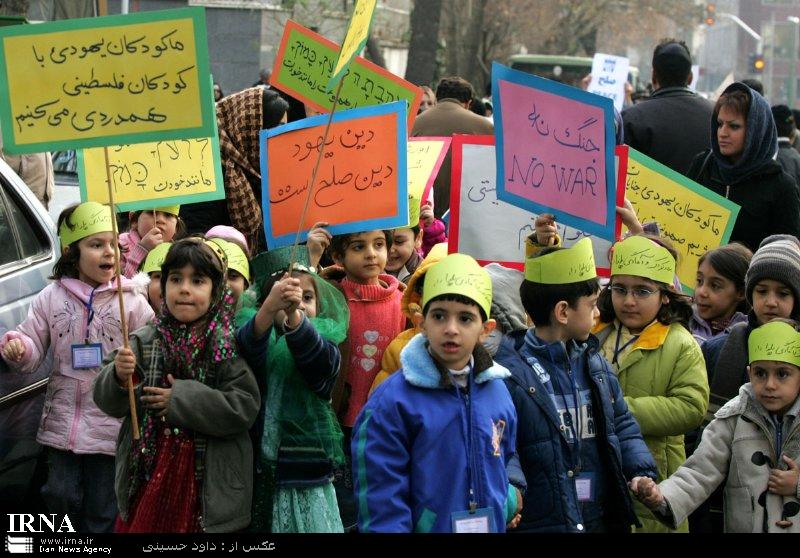
Missed Story: Iranian Jewish Protest

Iranian Jews protest Israeli war crimes in Gaza


31 Dec 2008
http://www.irna.ir

Iranian Jewish students and Jewish community gathered in front of the United Nations office in Tehran on Tuesday morning 30 Dec in order to protest Israeli war crimes and the slaughter of the innocent people in Gaza Strip.

The protestors, accompanied by Representative of Jewish Community at Majlis, Siamak Mara-Sedq, carried placards with anti-Israel slogans in both Farsi and Hebrew. Condemning Israel's savage attacks on defenseless people of Gaza for four days running, the protesters called for restoration of peace and security to the region.

"We are here to express our support and sympathy with the Palestinian nation" Rahmatollah Rafi, the chairman of Iran's Jewish community, said at the rally. The Jewish official also criticized certain Arab governments for their inaction and silence towards Israeli inhuman acts and war crimes in Gaza and the entire Palestinian territories.

Sphere: Related Content